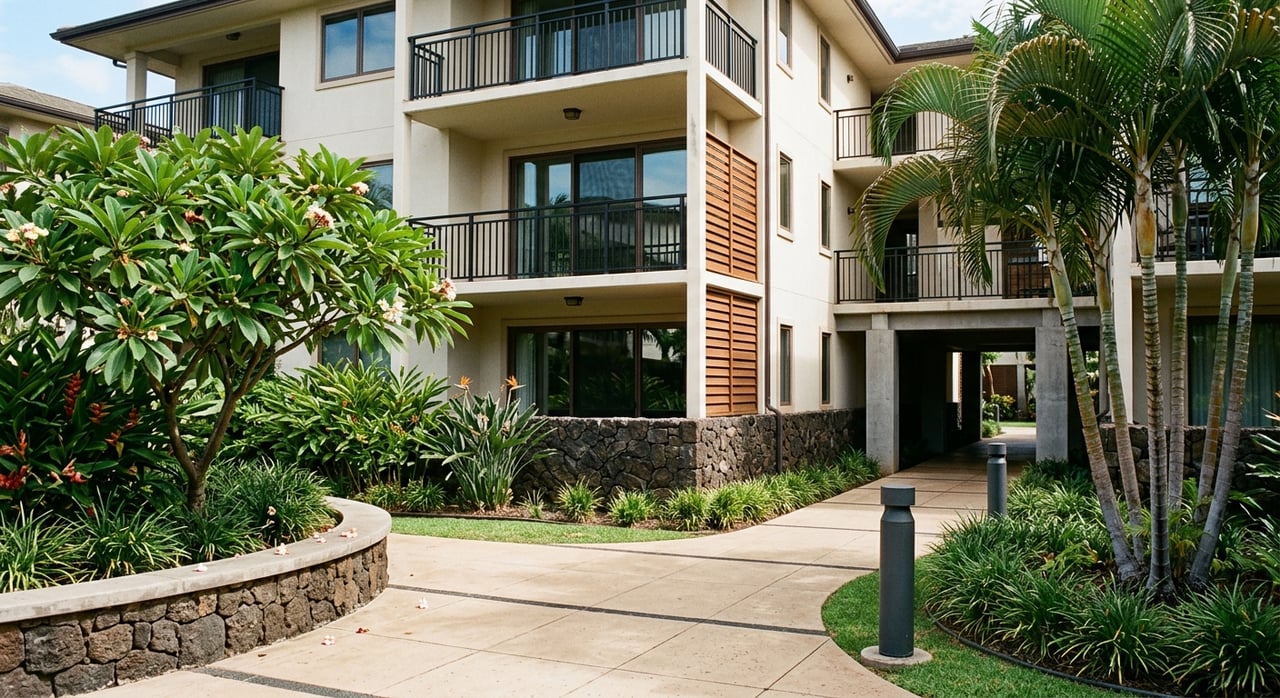
Drive down Alii Drive past Keauhou Bay this summer and you'll notice something that wasn't there two years ago: price reductions on oceanfront units at Kanaloa at Kona, at Keauhou Kona Surf & Racquet Club, at the smaller garden complexes tucked behind Kona Country Club. Sellers are cutting numbers. Buyers are taking their time. On paper, it looks like the moment condo shoppers have been waiting for.
The number on the for-sale sign isn't the number that decides what a Keauhou condo actually costs you every month. That number lives in a different document, the AOAO's insurance renewal notice, and it has been moving in the opposite direction.
What the Median Actually Says
As of June 2026, the year-to-date median condo price across the Kailua-Kona and Keauhou market had fallen to $570,000, down 14.3 percent from a year earlier, with closed sales down over 13 percent as well. Months of supply for condos stood at 6.9, and the typical unit was sitting on the market 51 days, well above the 36-day average for single-family homes in the same area. Financing is playing a bigger role too: roughly 46 percent of condo purchases this year have involved a mortgage, rising to about 55 percent for buyers shopping below the median price point.
Read on its own, that data says condos are getting cheaper and buyers are gaining leverage. Both are true. But a market where days on market climb even as prices fall usually means something more specific: buyers are pricing in a cost that isn't on the listing sheet.
Zoom out further and the softening looks smaller than it feels. In February 2020, the median condo in this market sold for around $340,000. Even after this year's pullback, buyers are paying roughly 68 percent more for the same category of unit. The 2026 discount is real, but it's a discount against a much higher baseline, not a return to pre-pandemic value.
The Insurance Math Nobody Puts on the Listing Sheet
Here's the part of the story that doesn't show up in a comps sheet. Hawaii's Department of Commerce and Consumer Affairs has confirmed there are only three admitted insurers currently writing condo building coverage in the state. When one of those insurers non-renews a building, the association is often pushed into the excess and surplus lines market, carriers not licensed in Hawaii and not subject to the state insurance commissioner's rate authority, meaning they can charge more for coverage nobody else will write.
That bottleneck is exactly why the premium swings have been so severe. When Hawaii Business Magazine first reported on the condo insurance crisis in 2024, it found associations statewide seeing master policy premiums increase 300 percent or more in a single year, with a handful of buildings hit with increases of 900 to 1,300 percent. Those increases are what pushed the legislature to act, and boards that absorbed them are still working the cost back into their budgets today. When an AOAO can't cover a jump like that through regular dues, it has three options: raise monthly fees, carry less than full replacement coverage, or issue a special assessment. None of those show up in a listing's price history.
The state has responded. Act 296, signed into law during the 2025 legislative session, was built to stabilize the market and address the hurricane coverage crunch that has hit condo associations hardest. That's a meaningful step, but it's a stabilization measure, not a reversal. Buildings that were already non-renewed or under-covered before the law passed are still working through that exposure now.
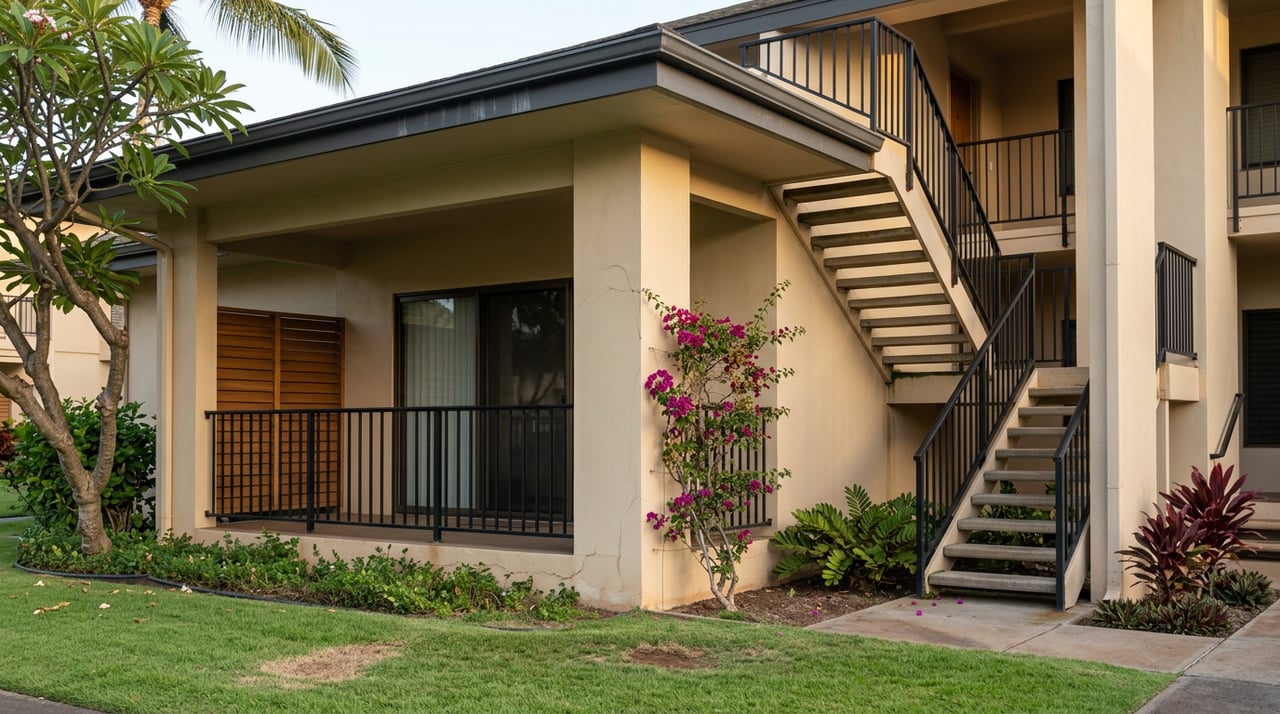
Keauhou's condo stock sits squarely in the profile insurers price hardest. Much of the oceanfront and ocean-view inventory along this stretch of coast, from the older resort complexes to the smaller garden-style buildings, was built between 1970 and 1995, and a good share of that dates specifically to the 1970s and 1980s. The state's own consumer guidance points out that Hawaii condo buildings from that period are now more than 40 years old, with the useful life of pipes, roofing, and other major systems already behind them. Add salt air and direct wave exposure, standard conditions for buildings perched on Keauhou's lava-rock coastline, and you have a combination that pushes premiums and reserve needs higher than a mainland buyer might expect.
What to Actually Pull From the Resale Package
A decade spent inspecting Big Island homes teaches you to distrust any number that hasn't been checked against the paperwork behind it. For a Keauhou condo, that paperwork is more important than the price history. Before writing an offer, ask for and read through:
- The reserve study, with its percent-funded figure. Industry guidance treats a reserve fund below 70 percent funded as a caution flag and below 30 percent as a real warning sign that a special assessment may be coming.
- The master policy declarations page. Check the coverage limit against the building's actual rebuild cost, and note whether the deductible is a flat dollar amount or a percentage of insured value, which matters far more after a hurricane than after a burst pipe.
- Your own HO-6 loss assessment limits. Standard policies often include loss assessment coverage as low as $1,000 and rarely more than $50,000 by default, according to Island Insurance's guidance for condo owners. If the association's deductible or coverage gap runs into six figures, a $50,000 cushion may not cover your share.
- Board meeting minutes from the past 12 to 24 months. Look specifically for any discussion of premium renewals, deferred maintenance, or a vote on a special assessment, even one that didn't pass.
- Whether the building's current insurer is admitted or surplus lines. That single fact tells you whether the association is paying market rates or crisis rates, and whether another non-renewal could hit at the next renewal date.
None of this shows up in an MLS printout. All of it shows up in the resale certificate and HOA document package a seller is required to provide, and all of it belongs in your due diligence period, not after closing.
Why This Might Still Be a Good Time to Buy in Keauhou
None of this means Keauhou is a bad place to buy a condo right now. It means the softer prices are creating real negotiating room, just not in the way the headline number suggests. A seller whose building has an insurance renewal coming due in the next few months often has real motivation to negotiate on price, credit part of the closing costs, or disclose the full financial picture upfront rather than let a buyer find it during escrow. That timing, not the square footage or the ocean view, is often the actual point of leverage in this market.
Older, well-run communities can still be a sound purchase when the numbers are visible and verified. Kanaloa at Kona, for example, sits on 17 acres of oceanfront land near Keauhou Bay with a long track record as a managed resort community, according to Castle Resorts' description of the property. Buildings like that can carry real value even in an insurance-tight market, provided the buyer has actually reviewed the reserve study and the master policy rather than reacting to a lower list price alone.
Frequently Asked Questions
What is loss assessment coverage, and do I need more than the standard amount? It's the part of your personal condo policy that pays your share if the association bills owners for damage or a deductible the master policy doesn't fully cover. Default limits are often modest, so it's worth reviewing your building's deductible and coverage gaps with an agent before assuming the standard amount is enough.
How do I find out if a Keauhou building has been non-renewed by its insurer? Ask for the current master policy's declarations page and confirm whether the carrier is an admitted Hawaii insurer or a surplus lines carrier. The resale document package should include this, and board minutes will usually reference any recent renewal difficulties.
Does a lower sale price mean the total cost of owning a Keauhou condo is lower too? Not automatically. A falling purchase price can be offset by higher monthly dues, a thinner insurance policy, or a pending special assessment. The only way to know the real cost is to read the AOAO's financials alongside the sale price, not instead of it.
If you're weighing a purchase in Keauhou and want a second set of eyes on an AOAO's reserve study or insurance history before you write an offer, Hawaii Development Group built its approach around exactly that kind of diligence. Schedule a private consultation to walk through a specific building's numbers before they become your numbers.