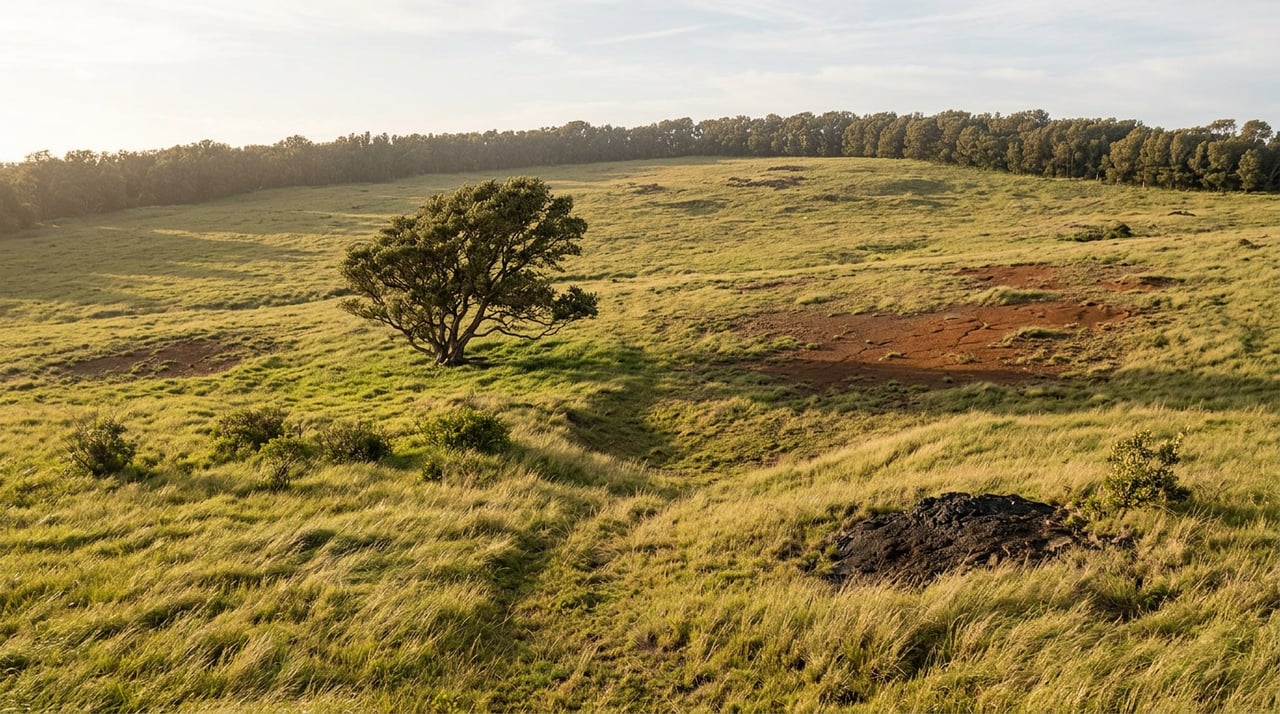
What does "water" actually mean on a North Kohala land listing? It sounds like a simple question until you compare two parcels that look nearly identical on paper and turn out to be entirely different purchases.
North Kohala is Hawaii Island's thinnest real estate market, and that thinness changes how buyers need to shop. When only a couple dozen properties trade in a year, you can't lean on a deep set of comparables the way you might in Kona or Waikoloa. You have to read each listing on its own terms, and the detail that separates a solid buy from a costly surprise usually isn't the acreage or the view. It's the water.
Two Listings, Same Price Range, Different Reality
Look at how differently two North Kohala land parcels can perform once you get past the headline price. In the 2023 sales cycle, a 10-acre lot at Puakea Bay Ranch, the gated horse-friendly subdivision just west of Hawi, sold for $450,000, holding steady with prior years. Meanwhile, two 20-acre parcels in the Kaiholena subdivision farther down the coast sold for $750,000 and $825,000, despite having no county water and no public electric service at all.
The Kaiholena parcels with fewer utilities and no grid connection sold for more overall, but less per acre, than the Puakea Bay Ranch lot with underground infrastructure and an HOA. The explanation is the view corridor at Kaiholena, which faces open ocean, sunset, and Maui sightlines strong enough that buyers committed to full off-grid living to get them. Puakea Bay Ranch, by contrast, sits inland with less dramatic ocean exposure but the convenience of established utilities.
Neither price is wrong. They're answers to different questions. A buyer comparing these two without understanding what "water" meant on each parcel would have no way to explain the gap, and would likely misprice their own offer on the next lot that came along.
North Kohala's Four Water Realities
North Kohala doesn't have one water system. It has at least four, and they rarely overlap on the same parcel.
| System | What it is | Where you'll find it |
|---|---|---|
| County water | Hawaii County Department of Water Supply metered service | Hawi and Makapala service areas |
| Private utility | Hawaii Business Express lists Kohala Ranch Water Company as a PUC-regulated private water company | Kohala Ranch subdivision only |
| Private well | A well, more common at upper elevations | Scattered upper-Kohala Ag parcels |
| Catchment | Rainwater capture into a cistern, no county or well connection | Rural Ag-zoned parcels outside the systems above, including areas like Kaiholena |
A parcel a few hundred yards from one with county water can be entirely dependent on catchment, because service areas in North Kohala don't expand in a predictable ring around town. Before comparing two listings, it's worth confirming with the County Department of Water Supply whether a meter exists or is even feasible for that specific parcel, since the answer can vary lot to lot in a way a satellite photo won't show you.
Wells deserve their own caveat too. They show up more often at the upper elevations of North Kohala's Ag land, but a well isn't something you can simply drill on arrival.
Why Acreage Doesn't Scale the Way You Think
Most land in North Kohala outside the gated subdivisions carries Ag-20a zoning. That zoning reshapes how you should think about price per acre.
Whether you buy a 4-acre parcel inside an already-subdivided gated community or a raw 39-acre Ag-20a lot outside one, the zoning is part of the comparison. A larger raw parcel offers more land, which matters enormously for privacy and ranching or farming use, but doesn't function like a multiplier on value the way acreage does in places with more permissive subdivision rules.
This is also why price per acre is a misleading metric for comparing North Kohala listings against each other. A buyer optimizing for privacy and grazing land wants different things from a buyer optimizing for a small footprint near town services, and the zoning treats both the same way on the residential count while treating them very differently on usable purpose.
What Kohala Ranch Does Differently
Kohala Ranch is a distinct case. As a gated agricultural subdivision spanning more than 3,500 acres, it offers smaller home lots than the surrounding Ag-20a land. Lots run from under an acre in the lower-elevation Heathers I and Heathers II sections, to three to five acres in the mid-elevation Meadows I and Meadows II, up to ten acres or more in the upper-elevation Summit area.
Water inside Kohala Ranch comes from the Kohala Ranch Water Company, a private utility that runs underground lines to each property, distinct from both the county system serving Hawi and the catchment reality found on many surrounding Ag-20a parcels. That distinction is worth confirming directly, because a listing that simply says "water" without naming the provider could mean county service, ranch utility service, or nothing connected at all, depending on which side of the subdivision boundary the parcel sits.
A short drive toward the coast, the gated Kohala Waterfront community shows a different model again. With only 50 residential lots on a third to a little over half an acre each, home prices there start around $2.2 million and carry monthly HOA fees near $450, reflecting a small, cliffside, resort-adjacent footprint rather than the ranch-style acreage further inland. Three subdivisions, three water arrangements, three very different products, all inside the same North Kohala district.
Why This Matters More When Inventory Is Thin
North Kohala recorded just 22 residential sales over the twelve months ending in April 2026, at an average price of $1,265,374, making it the thinnest sub-market on the island even as it competes with Kona-level pricing. With that few transactions, buyers rarely get the luxury of walking away from one listing to find a near-identical comparable down the street. When something workable appears, the pressure to move quickly is real, and that's exactly when skipping the water and zoning questions costs the most.
A slower market elsewhere might let you wait out due diligence at a comfortable pace. In North Kohala, the next listing with a similar price and similar acreage might not show up for months, and it may carry a completely different water arrangement when it does.
Questions to Ask Before You Write an Offer
- Which system serves this specific parcel: county meter, Kohala Ranch Water Company, a private well, or catchment only?
- If catchment, what storage capacity and filtration exist, and what's the realistic budget for tanks, pumps, and maintenance?
- If a well, what paperwork is in place, and what remains to be done before you proceed?
- Is the parcel zoned Ag-20a, and if so, does the acreage actually expand what you can build, or only what surrounds it?
- Is road access county-accepted or private, and is there a recorded maintenance agreement if it's private?
Frequently Asked Questions
Is catchment water safe to drink in North Kohala? Many households use catchment water for washing and irrigation while relying on filtration systems or county fill stations for drinking and cooking water. The right setup depends on the filtration equipment installed and how the previous owner maintained the system, which is worth verifying directly rather than assuming.
What should I check about Ag-20a zoning before making an offer? If your plans depend on what the zoning allows, confirm current rules before you write an offer rather than after.
North Kohala rewards buyers who ask about the water before they ask about the view. If you're comparing land in Hawi, Kapaau, Kohala Ranch, or the surrounding Ag-20a country and want a second set of eyes on what a specific parcel's water and zoning actually allow, Hawaii Development Group is a good place to start that conversation. Schedule a Private Consultation before you commit to a number that may not mean what it looks like on paper.
This article is general information, not legal, tax or financial advice. Consult a qualified professional about your situation.